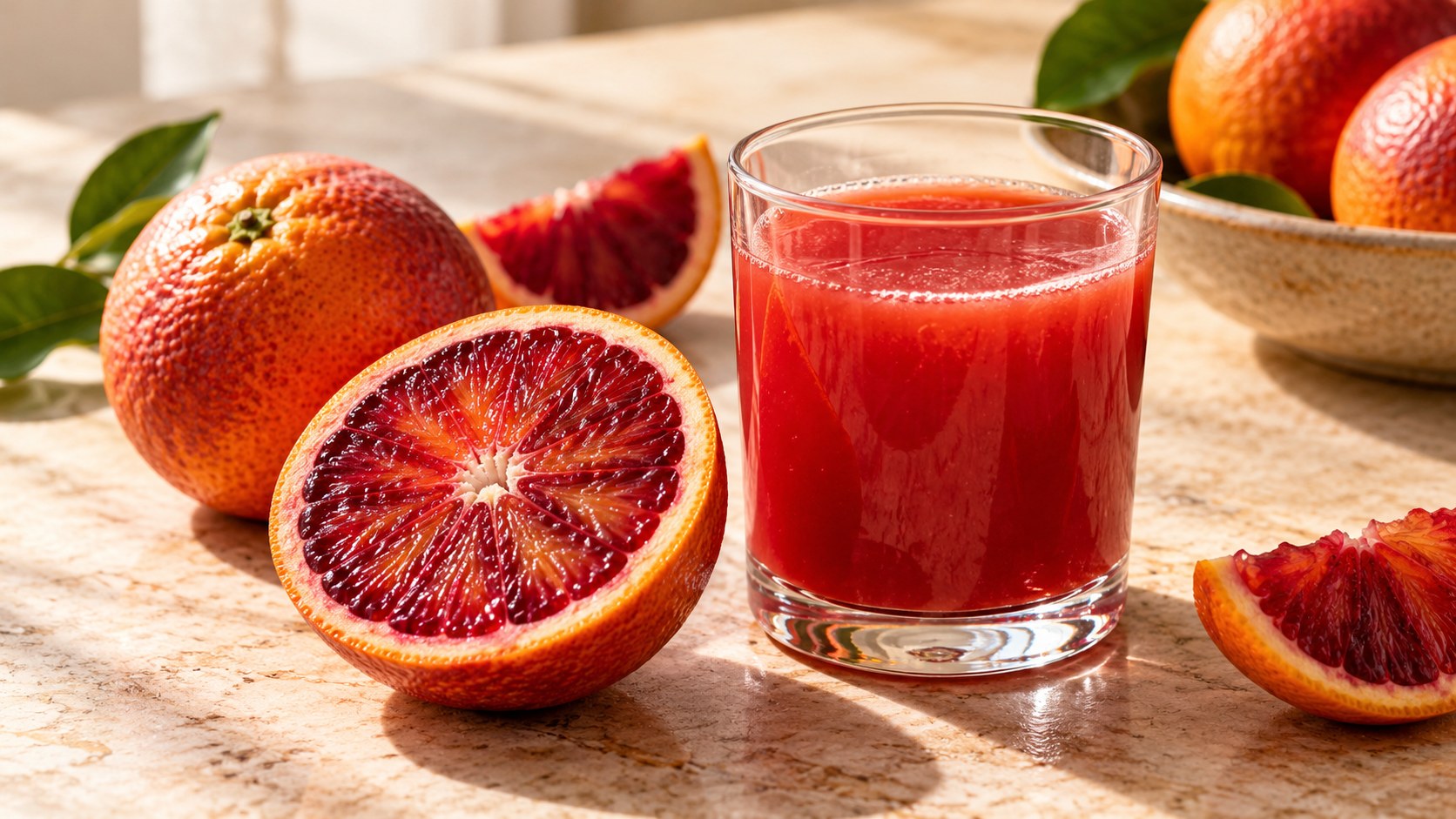
Blood orange juice is often promoted as a heart-healthy drink because it contains anthocyanins, flavanones, and other plant compounds. These substances have attracted scientific interest for their potential effects on blood vessel function and cardiovascular health.
But there is an important distinction between a promising biological mechanism and a proven health benefit. Human studies of blood orange juice have reported improvements in some measures of blood vessel function, while other trials have found no meaningful differences in cholesterol or several established cardiovascular risk markers.
Here is what the research actually shows, including what remains uncertain.
How Could Blood Orange Juice Affect Heart Health?
Blood oranges contain several naturally occurring compounds that may be relevant to cardiovascular health.
Anthocyanins give the fruit its characteristic red or purple flesh. Blood oranges also contain flavanones, including hesperidin and narirutin, as well as vitamin C and other plant compounds.
Researchers are interested in how these substances may influence endothelial function, oxidative stress, and inflammatory processes. The endothelium is the thin layer of cells lining blood vessels. Its function helps regulate how blood vessels relax and respond to changes in blood flow.
These mechanisms provide a scientific reason to study blood orange juice. They do not, by themselves, prove that drinking it prevents heart attacks, strokes, or other cardiovascular diseases.
What Human Studies Say About Blood Vessel Function
One of the more interesting findings comes from a randomized, controlled, crossover trial published in The Journal of Nutrition in 2020.
The study included 15 adults with overweight or obesity. Participants consumed 200 mL of blood orange juice twice daily for two weeks, then completed a separate control-drink period.
Researchers measured flow-mediated dilation (FMD), a test used to assess how well an artery responds to increased blood flow.
FMD increased from an average of 8.15% to 10.2% during the blood orange juice period. The sugar-matched control drink did not produce the same improvement. However, blood pressure, cholesterol, and several inflammatory markers did not change significantly.
The result suggests that blood orange juice may influence blood vessel function in the short term. The trial was small and lasted only two weeks, so it cannot establish whether the change translates into fewer cardiovascular events over time.
Research source: Blood Orange Juice Consumption Increases Flow-Mediated Dilation in Adults with Overweight and Obesity: A Randomized Controlled Trial
Does Blood Orange Juice Lower Cholesterol?
The available evidence does not support a confident claim that blood orange juice lowers LDL cholesterol more effectively than regular orange juice.
A randomized crossover trial published in 2018 included 41 participants who consumed 500 mL of anthocyanin-rich blood orange juice daily for 28 days and, during a separate study period, the same amount of standard orange juice without anthocyanins.
Researchers found no significant differences between the two drinks in LDL cholesterol, total cholesterol, triglycerides, blood glucose, or several other cardiovascular risk markers.
This is an important result because blood orange juice contains more anthocyanins than many ordinary orange varieties. A higher concentration of a potentially beneficial compound does not automatically produce a measurable improvement in every health outcome.
The study also does not establish that blood orange juice has no cardiovascular value. It shows that, under the conditions tested, it did not outperform standard orange juice on the measured outcomes.
What About Blood Pressure and Inflammation?
Some smaller studies have reported encouraging results beyond cholesterol.
A randomized, placebo-controlled crossover study involving 19 non-diabetic adults with elevated cardiovascular risk found that one week of consuming 500 mL of red orange juice daily improved FMD and reduced several inflammatory markers, including high-sensitivity C-reactive protein, IL-6, and TNF-α.
However, the intervention lasted only seven days. The participants also had elevated cardiovascular risk, so the findings should not automatically be applied to everyone.
Another small study of 12 overweight women who consumed 500 mL of Moro blood orange juice daily for four weeks reported improvements in blood pressure and certain metabolic markers. Because the study was small and lacked a separate control group, it is difficult to determine how much of the observed change was caused by the juice itself.
Taken together, these studies suggest that blood orange juice deserves further research. They do not establish that it reliably lowers blood pressure or treats chronic inflammation.
Are Anthocyanins the Reason Blood Orange Juice May Help?
Anthocyanins are a plausible contributor, but they are not the only compounds that may matter.
Blood orange juice also contains flavanones, including hesperidin and narirutin. In the 2020 trial, urinary metabolites of hesperidin increased after participants consumed blood orange juice. The researchers proposed that metabolites of anthocyanins and flavanones might work together to influence pathways involved in blood vessel function.
However, the trial did not isolate each compound's individual effect. It therefore cannot tell us exactly how much of the observed change was due to anthocyanins, flavanones, or their combination.
Blood orange varieties also differ in pigment content. The concentration of anthocyanins in a glass of juice depends on factors such as the variety of orange and how the juice is processed and stored.
This is why results from a particular research preparation should not be treated as a guarantee that every commercial blood orange juice will produce the same effect.
Is Blood Orange Juice Better for Your Heart Than Regular Orange Juice?
The answer is not yet clear.
Blood orange juice offers anthocyanins that are generally less abundant in ordinary blonde orange juice. That gives it a distinctive nutritional profile and makes it interesting for cardiovascular research.
Nevertheless, the direct comparison trial discussed above did not find significant improvements in cholesterol or the other measured cardiovascular markers compared with standard orange juice.
If you enjoy blood orange juice, its distinctive flavor and plant compounds can be reasons to include it in a balanced diet. There is not enough evidence to recommend switching from ordinary orange juice solely to lower cholesterol or prevent heart disease.
It is also worth considering the amount consumed. Fruit juice contains natural sugars, and large servings can add substantial sugar and calories without providing the same satiety as whole fruit.
How Much Blood Orange Juice Should You Drink?
There is no established daily dose of blood orange juice that has been proven to prevent cardiovascular disease.
The amounts used in research are experimental doses, not necessarily everyday drinking recommendations. Some studies used 400 mL per day for two weeks, while others used 500 mL per day for several weeks.
Those quantities should not be interpreted as a recommendation to drink that much juice. For everyday consumption, consider the serving size, sugar content, your overall diet, and any advice you have received for managing blood glucose or triglycerides.
If your main goal is to obtain fiber as well as citrus nutrients, eating a whole orange is another practical option. Juice and whole fruit are not nutritionally interchangeable.
Who Should Be Careful With Blood Orange Juice?
Blood orange juice can fit into many diets, but a few considerations are worth keeping in mind.
- People managing blood glucose: Check the carbohydrate and sugar content of the serving rather than assuming that natural fruit sugar has no effect on blood glucose.
- People with acid reflux: Citrus juice may trigger symptoms in some individuals. Personal tolerance matters.
- People monitoring calorie intake: Juice can be easy to consume quickly, so portion size matters.
- People taking medication: Check the instructions for your specific medicine if you have questions about citrus juice interactions. Do not assume that all citrus fruits interact with all medications in the same way.
Blood orange juice should not replace prescribed medication or established cardiovascular care.
What Can We Conclude From the Research?
Human studies provide some evidence that blood orange juice may improve short-term measures of blood vessel function. Other research has reported changes in selected inflammatory or metabolic markers.
The evidence is less convincing for claims that it lowers LDL cholesterol, consistently reduces blood pressure, or prevents cardiovascular disease. Several trials were small, short, or limited to particular groups of participants.
The most accurate conclusion is that blood orange juice is a source of interesting plant compounds, and its potential cardiovascular effects deserve further investigation. It can be part of a balanced diet, but it should not be presented as a proven treatment for heart disease.
# Blog 2: