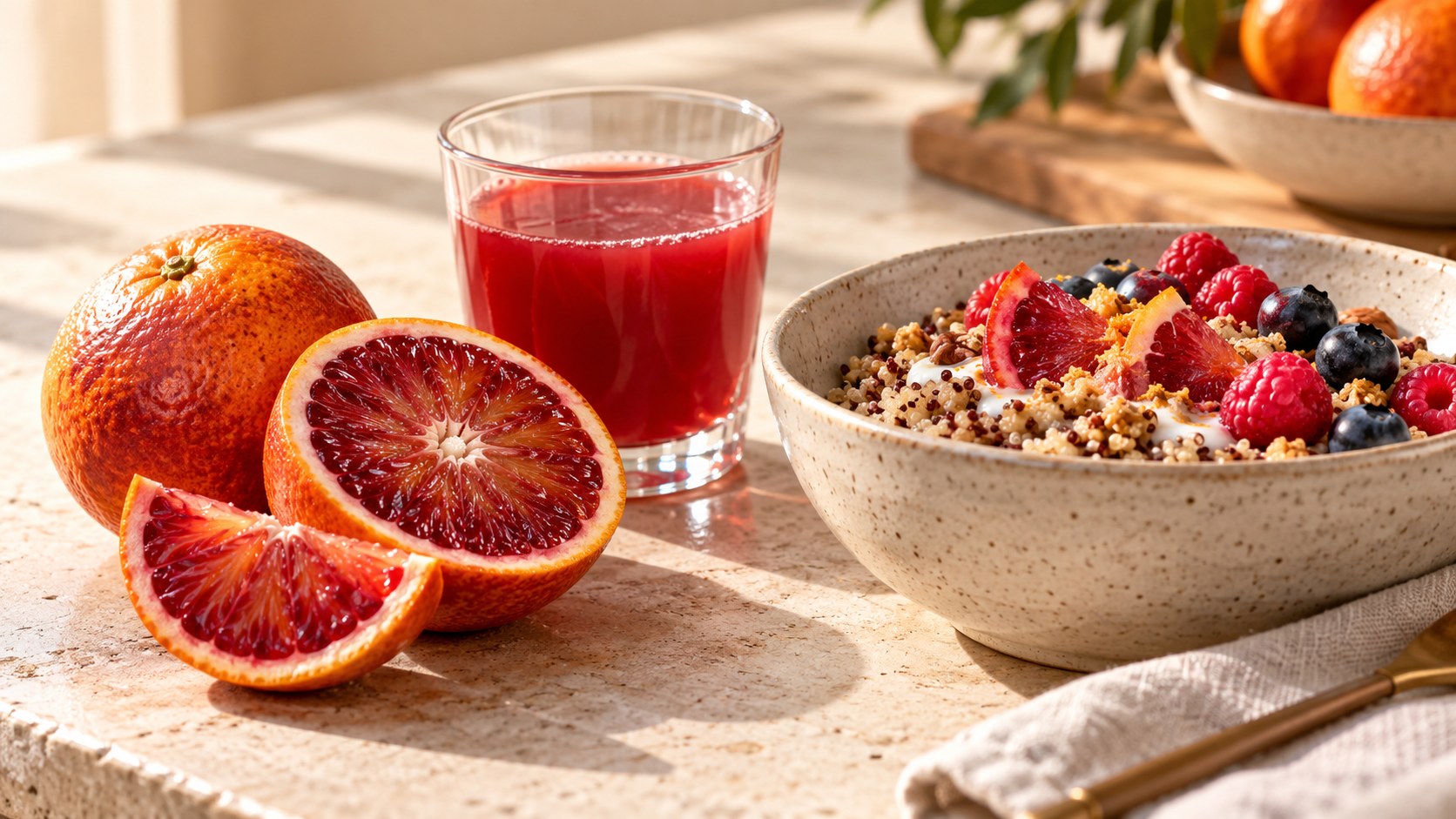
Blood orange juice is best known for its deep red color and its content of anthocyanins and other plant compounds. But could it also affect the bacteria living in your gut?
Researchers have started investigating this question. One human study found that drinking Moro blood orange juice was associated with changes in specific gut bacteria and increases in certain short-chain fatty acids. Some metabolic markers also improved during the study.
These findings are interesting, but they do not mean that blood orange juice is a proven treatment for digestive problems or that it improves everyone's gut health. Here is what the research tells us, what remains uncertain, and how blood orange juice compares with other ways of supporting a healthy gut.
How Could Blood Orange Juice Affect Gut Bacteria?
Your gut contains a large community of microorganisms, collectively known as the gut microbiota. These microorganisms interact with components of your diet, including some plant compounds that are not fully absorbed in the small intestine.
Blood oranges contain flavanones such as hesperidin and narirutin, along with anthocyanins such as cyanidin-3-glucoside. These compounds are studied for their possible biological effects, including interactions with gut microorganisms.
Some plant compounds and their metabolites may influence the activity or abundance of particular bacteria. Gut bacteria can also transform dietary compounds into other substances that the body absorbs or uses.
However, a food's potential to influence gut bacteria does not automatically mean it improves digestion, relieves constipation, or treats a digestive condition. The effect depends on the food, the amount consumed, the person's existing gut microbiota, and other aspects of their diet.
What Did the Human Study Actually Find?
A 2023 study published in Frontiers in Microbiology investigated Moro blood orange juice in 12 overweight women aged 18–37.
Participants drank 500 mL of pasteurized Moro blood orange juice every day for four weeks. Researchers collected stool and blood samples before the intervention and after two and four weeks.
The researchers reported several findings:
- The abundance of certain gut bacterial groups changed during the intervention.
- The overall diversity and general composition of the gut microbiota did not change significantly.
- Levels of certain short-chain fatty acids increased, particularly propionic acid and isobutyric acid.
- Some cardiometabolic markers, including blood pressure and fasting glucose, improved during the intervention.
These results suggest that Moro blood orange juice may influence particular aspects of the gut microbiota and its metabolic activity.
There is an important limitation, though: the study included only 12 participants and did not have a separate control group. Because the participants were overweight women, the results also cannot automatically be generalized to men, people of other ages, or people with digestive disorders.
Original research: Blood Orange Juice Intake Changes Specific Bacteria of Gut Microbiota Associated with Cardiometabolic Biomarkers
What Are Short-Chain Fatty Acids, and Why Do They Matter?
Short-chain fatty acids (SCFAs) are substances produced when gut microorganisms process certain dietary components. They include acetate, propionate, and butyrate, which have different roles in the body.
Some SCFAs help provide energy to cells lining the colon. They also participate in processes related to intestinal barrier function, immune signaling, and metabolism.
This is one reason researchers study how foods affect SCFA production. A change in these compounds may provide clues about how the gut microbiota responds to a particular diet.
In the blood orange juice study, researchers observed increases in propionic acid and isobutyric acid. These findings should be interpreted carefully, however.
Not all SCFAs have identical functions, and an increase in one compound does not necessarily mean that overall gut health has improved. The study also did not establish that drinking blood orange juice prevents intestinal disease or relieves everyday digestive symptoms.
In other words, the results offer a possible mechanism worth investigating rather than proof of a specific digestive benefit.
Does Blood Orange Juice Increase Good Gut Bacteria?
There is no simple answer because gut bacteria cannot always be divided neatly into universally good and bad categories.
The effects of a particular microorganism can depend on its strain, its abundance, the surrounding microbial community, and the person's health. A change in the relative abundance of one bacterial group does not necessarily indicate a healthier gut overall.
In the 2023 study, some bacterial groups changed after participants drank Moro blood orange juice, but the overall diversity and general composition of the gut microbiota did not change significantly.
That distinction matters. Greater microbial diversity is sometimes associated with a healthy gut, but diversity alone is not a complete measure of gut health. Likewise, an increase in a particular bacterial group is not automatically beneficial.
The most accurate interpretation is that blood orange juice may affect selected gut microorganisms, while the broader consequences of those changes remain uncertain.
Can Blood Orange Juice Help With Constipation?
The available study does not establish that blood orange juice relieves constipation.
One important factor is fiber. Whole oranges contain dietary fiber, including pectin, which contributes to normal digestive function. When oranges are juiced, some of their fiber is removed, particularly when the juice is heavily filtered.
Blood orange juice can retain some fiber depending on how it is prepared, but it generally does not provide the same amount as eating the whole fruit.
If your goal is to support regular bowel movements, it is more useful to consider your overall fiber intake, fluid intake, physical activity, and usual bowel habits rather than relying on blood orange juice alone.
If constipation is persistent, severe, or accompanied by symptoms such as blood in the stool or unexplained weight loss, seek medical advice rather than attempting to manage it with juice.
Is Blood Orange Juice Better for Gut Health Than Regular Orange Juice?
Current evidence is insufficient to establish that blood orange juice is better for gut health than ordinary orange juice.
Blood oranges have a distinctive anthocyanin content, while both blood oranges and regular oranges contain flavanones and other citrus compounds. Their composition varies according to the variety, growing conditions, processing method, and storage.
The 2023 blood orange juice study examined changes during consumption of Moro juice, but it did not include a separate group drinking ordinary orange juice. It therefore cannot tell us whether the observed changes were unique to blood oranges or would also occur with standard orange juice.
If you enjoy the flavor of blood oranges, they are a reasonable fruit choice. But there is not enough direct comparative evidence to recommend blood orange juice specifically for improving gut health.
Does Pasteurized Blood Orange Juice Still Have Potential Benefits?
The human gut microbiota study used pasteurized Moro blood orange juice, so its findings were not limited to freshly squeezed, unpasteurized juice.
This is a useful detail because pasteurization and other processing methods can affect some heat-sensitive compounds. The final composition also depends on processing conditions, packaging, and storage.
The study does not establish that pasteurized juice and fresh juice have identical effects on gut bacteria. Nor does it show that unpasteurized juice offers greater digestive benefits.
When choosing a product, check whether it contains added sugar and consider its fiber content and serving size. Pasteurization is also an important food-safety measure, particularly for people who may be more vulnerable to foodborne illness.
How Much Blood Orange Juice Should You Drink for Gut Health?
There is currently no scientifically established daily amount of blood orange juice that has been proven to improve gut health.
The human study used 500 mL per day for four weeks, but that was a research protocol, not a general drinking recommendation. The study was small, and it did not determine the minimum amount needed to produce an effect.
Drinking larger amounts is not necessarily better. Fruit juice contains natural sugars, and a large serving can contribute considerable sugar and calories. For many people, eating whole fruit more often is a practical way to obtain fiber while enjoying citrus nutrients.
If you choose blood orange juice, consider a moderate serving and account for it as part of your overall diet. People who experience reflux or stomach discomfort after drinking citrus juice may also need to adjust their intake.
What Is the Best Way to Support a Healthy Gut?
Blood orange juice can be one component of a varied diet, but there is no reason to rely on one drink to support the gut microbiota.
A more established general approach is to eat a range of fiber-containing foods, including whole fruits, vegetables, legumes, whole grains, nuts, and seeds, according to your individual needs and tolerance.
Different foods supply different fibers and plant compounds, giving gut microorganisms a wider range of materials to process. Drinking enough fluids and maintaining regular physical activity can also support normal bowel function.
If you already enjoy blood orange juice, you can include it in that broader dietary pattern. The current evidence does not justify treating it as a probiotic drink or a replacement for fiber-rich foods.
What Can We Conclude About Blood Orange Juice and Gut Health?
The research provides preliminary evidence that Moro blood orange juice may influence specific gut bacteria and short-chain fatty acids. A small human study also found changes in selected metabolic markers during four weeks of consumption.
However, the study did not demonstrate an improvement in overall gut microbial diversity, and it did not establish that blood orange juice treats constipation, prevents digestive disease, or improves gut health in the general population.
More controlled studies with larger and more diverse groups are needed to determine whether these changes are reproducible and whether they translate into meaningful digestive benefits.
For now, blood orange juice is best viewed as a citrus drink with potentially interesting effects on the gut microbiota, rather than a proven solution for digestive problems.
# Blog 3: